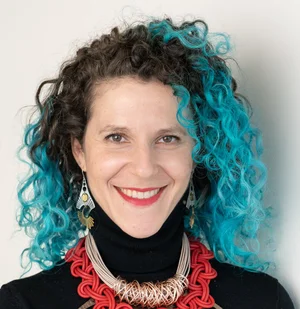
In spring and summer, I like to work as much as I can on the back porch.

I love having so much green in my field of vision, and the backyard birds are always good for a fair amount of drama.
Right now, the year's baby birds have fledged, so there are handfuls of scruffy adolescent woodpeckers and sparrows and nuthatches and finches all flitting around trying to figure out their wings and shedding their baby fluff feathers.
The summer heat is soaking into my pores these days. It's lovely and also soporific, so there are also porch naps involved in my work days out here.
It also, to be perfectly frank, is not the most encouraging to standard-definition productivity. As the days heat up, my brain achieves a pleasant foggy relaxed feeling. It's great for lowering my underlying anxiety about the world. It's the antithesis of the sharp focus I rely on to be decisive and move through the to-do list.
And yet, I'm not moving inside to work. (Well, sometimes I am, when the humidity and temperature climb beyond a certain point.) I'm leaning into the summer-induced softness.
It's not my natural inclination to take things slow and accept that there are times when making big, sudden, decisive leaps is counterproductive. But here I am, in just such a moment.
Summertime slow down

As I've shared before, I'm in a phase of metamorphosis in my business. I've started my work with Jessica Abel as a coach, helping me figure out a new business offer I can rely on for some income. Working through the Notion board of our coaching HQ (kindly set up by Jessica complete with pirate themed imagery) has been a bit like therapy.
Lots of pondering over Big Questions. What do I want working to look like in my life? What is fun for me that others struggle with? What are the natural cycles of energy that I work within? What drains me, and what pumps me up?
As with any good coaching process, I'm getting a big chunk of help just out of getting all these thoughts down in one place to see them for myself.
Relevant case in point, here's what I wrote about my seasonal energy cycles:
I tend to feel a great deal of loosening, sap-running potential in the spring, which is when I often have the urge to try or launch new business projects. Summer is a lower energy season for me, where I want to be loose and easy in the heat. Fall is usually a season of focus, where I don’t necessarily feel an abundance of energy but a desire to channel my energy into specific things. Winter feels like a low-energy hum, where I’m happy to stay busy but don’t tend to want to kick off new things.
I know summers are a low energy time for me. I know it's helpful to have reminders that slow is good. I know that I'm about to head up to Maine for my annual August retreat of reading and disconnection from the internet.
So why is there still a part of me chafing at this season of slow?
To strive or not to strive
If you read along with my week-long experiment of letting tarot cards run my business, you may have been introduced to my inner striver, Atalanta.
She's the go-getter voice inside me who motivates me to keep trying new things with my whole heart. I appreciate her and rely on her, but proceeding slowly and carefully in my summer-energy heat is not her style.
Atalanta has been the voice that directed a lot of my life and career decisions. She's used to getting her way.
But now is a season when the world around me is telling me to slow down in the heat, to conserve my energy for what's really important (see the animals that are only coming out in the early morning and dusky evening, or the plants that are letting their leaves' photosynthesis keep them alive as-is without growing taller in the lack of rain).
This is not Atalanta's moment to lead the way.
One of the practices I adopted during my recently-wrapped Reimagining Leadership program is Rebecca's Carrying The Question process, in which you identify an important question and journal on it weekly throughout a cycle (menstrual, lunar, etc). A question I spent a cycle with was
What's the place of striving right now?
In working with that question, I realized that I tend to associate striving energy with my fiery Aries stubborn forcefulness. That striving is something I've always looked at as only the hard-charging decisive ambition that I've often turned to.
Right now I want striving to include softness and humility. Striving that can encourage me to try new things without brow-beating me to do more. Striving that feeds my excitement about a new idea without the pressurized expectation that that idea will be a magic bullet solution. Striving as a fire's banked embers rather than snapping flames. Striving as summer warmth rather than a bolt of lightning.
This transformative moment of caterpillar goo as I figure out how to make my business be what I want it to be in my life, it's a time to work inwardly, to give new ideas a rich ground for germination. I'm striving quietly, with sunshine soaking into me rather than heat burning me up.
The value of discernment
Reimagining Leadership was a great way to explore who I want to be as a leader, which is now in my mind as I work through this coaching model with Jessica.
One of the final writing prompts Rebecca gave us was to think about an image in nature that could represent the kind of leadership we wanted to represent in the world.
What I came to was the mycorrhizal network that connects fungi and plants underground to share nutrients and messages. It's a representation of the kind of leadership-as-connection and leadership-as-discernment that I'm working to embody.
While the ego-driven part of myself still wants public recognition for my work, what I actually find most fulfilling is being someone who makes new connections. Connections between people, connections across multiple genres, connections between someone's problem and new ways they might solve that problem that they haven't thought of.
Here's how that discernment looks in practice.
A discerning leadership case study
I'm currently working with the Boston Public Library to reinvent what guided experiences might look like in their central branch on Boylston Street, which combines a historic Renaissance-inspired building with a modern municipal library that's one of the oldest of its type in the USA.
What's been needed in that process of moving away from the long-running 1-hour guided tours is someone from the outside who can come in and guide the transition from the familiar old way to the unknown new one.
I've spent hours in conversation with both library staff and the volunteer guides who've been leading the tours (some for 30+ years) about what is working, what isn't working, and what alternatives might be tried.

There have been lots of ideas and lots of Big Feelings. Among the folks I've spoken to are many points of view about how the transition is going, what is motivating it, and who should determine what comes next.
I just finished leading a couple of prototyping sessions with guides and staff at the library, in which they used visitor personas and scenarios, combined with creative constraints, to brainstorm alternative experiences they might offer to library patrons.
We don't know what's coming next, but we're circling around a couple of exciting possibilities. I'm working to help all the various stakeholders in this situation see the uncertainty as full of potential, as well as, yes, scary.
The library team is relying on my discerning leadership to connect this time of transition with the playful, imaginative techniques we're using to make the transition happen. I'm introducing some of them to new ideas and helping them take those onboard to consider. I'm reminding them that we can hold our outcomes lightly and not make quick and forceful decisions.
I'm keeping Anne Laure le Cunff's advice (in her book, Tiny Experiments) in mind that
“Times of disruption are an opportunity to relax your grip on the outcome while you keep on showing up.”
Bringing the discernment home
So here I am, in my summer-soaked attempt to strive gently and lead with discernment, and look how readily I can apply it in a context with an organizational client, but how much more I struggle with it when I've got to apply it to my own business development.
Because of course, it's all well and good to lead a discerning process when the outcome is a client project that I will be involved in for as long as this contract goes.
But it's much harder to sit in the quiet, internal, germinating work of discerning what new business offer I can create for individual clients of my own.
When I'm the one having the lots of ideas and Big Feelings about how my work success is and is not connected to my sense of self worth.
Recently, journaling about the kind of change-making role I want to play, I wrote this down:
I’m the one that reminds people of the importance of imagination and play and dreaming so that they can invent the new ways ahead. I don’t want the pressure of a Big Solution on my shoulders. Instead I want to be a set of shoulders for someone who will have the Partway Solution and another someone after that who will have the Rest Of The Way Solution.

But, of course, sometimes discernment means making a decision and moving ahead. "Decide and move on" is one of the options on my cues wheel for moments when I'm stuck.
As I continue documenting and sharing my process of reconfiguring my business, here's a reminder to myself (and maybe to you, too) to take the discernment I'm leading for others and remember that what I decide to pilot in my coaching work doesn't have to be a Big Solution.
All I can do—all any of us can do, really—is find the Partway Solution or the For Now Solution or the Let's Try This Solution.
Because metamorphosis doesn't happen all at once, and there's no use trying to know exactly what things will look like on the other side of it.
"The things we want are transformative," says Rebecca Solnit in A Field Guide to Getting Lost, "and we don’t know or only think we know what is on the other side of that transformation."
Onward into the uncertain process of transformation we go!
Creative Prompt Coda: Reflect on where you tend to get yourself stuck. Create a list of 6-10 cues for yourself to help move forward. Put those cues together into a tool you can use to get yourself out of a rut.