Today’s blog is a writing experiment. I’m writing this all in one go, in one hour, trying not to stop or revise too much, and posting what I end up with.
I’ve been doing more writing recently, and the more I do, the more I feel like I get a handle on my thoughts, so I’m trying a number of techniques to keep it feeling fresh for myself.
This is drawing a little bit from Seb Chan’s Fresh & New, which he describes as “low-filter fast writing”. It’s drawing a little bit from Julia Cameron’s The Artist’s Way morning pages idea (where you free-write for three longhand pages). And it’s drawing a little bit from Neal Gaiman’s advice to either write or do nothing (the idea being that writing, eventually, will become the more appealing of the two options).
That Neal Gaiman approach is the one referenced at the start of many a Writer’s Hour, and this is where we get to the subject of communality that I want to muse over today.
Writer’s Hour is a wonderful invention of These Pannacotta Times. It’s hosted by a rotating crew of London Writer’s Salon folks from around the world, and at 4 different times throughout the day, on weekdays, there’s a free Zoom call that anyone can join. The format is this (note the beautifully simple version of opening and closing rituals):
We all show up in our Zoom boxes, saying hi before the hosts mute everyone.
The hosts explain the goals of the hour (that we’re here to write and keep the chat to a minimum for focus).
We set our intentions for what we’re working on in the chat, and the hosts read some of those intentions aloud.
Someone reads aloud a writing-focused quote chosen by a community member, which is also shared in the chat.
We raise a glass of whatever we’re drinking.
We write for 50 silent minutes.
One of the hosts soothingly comes back on audio to end our time with a reminder that if we’re in flow, we can all jump off the call or mute it.
Folks are invited to share what we’ve accomplished in the chat and leave with a one-word checkout.
We leave.
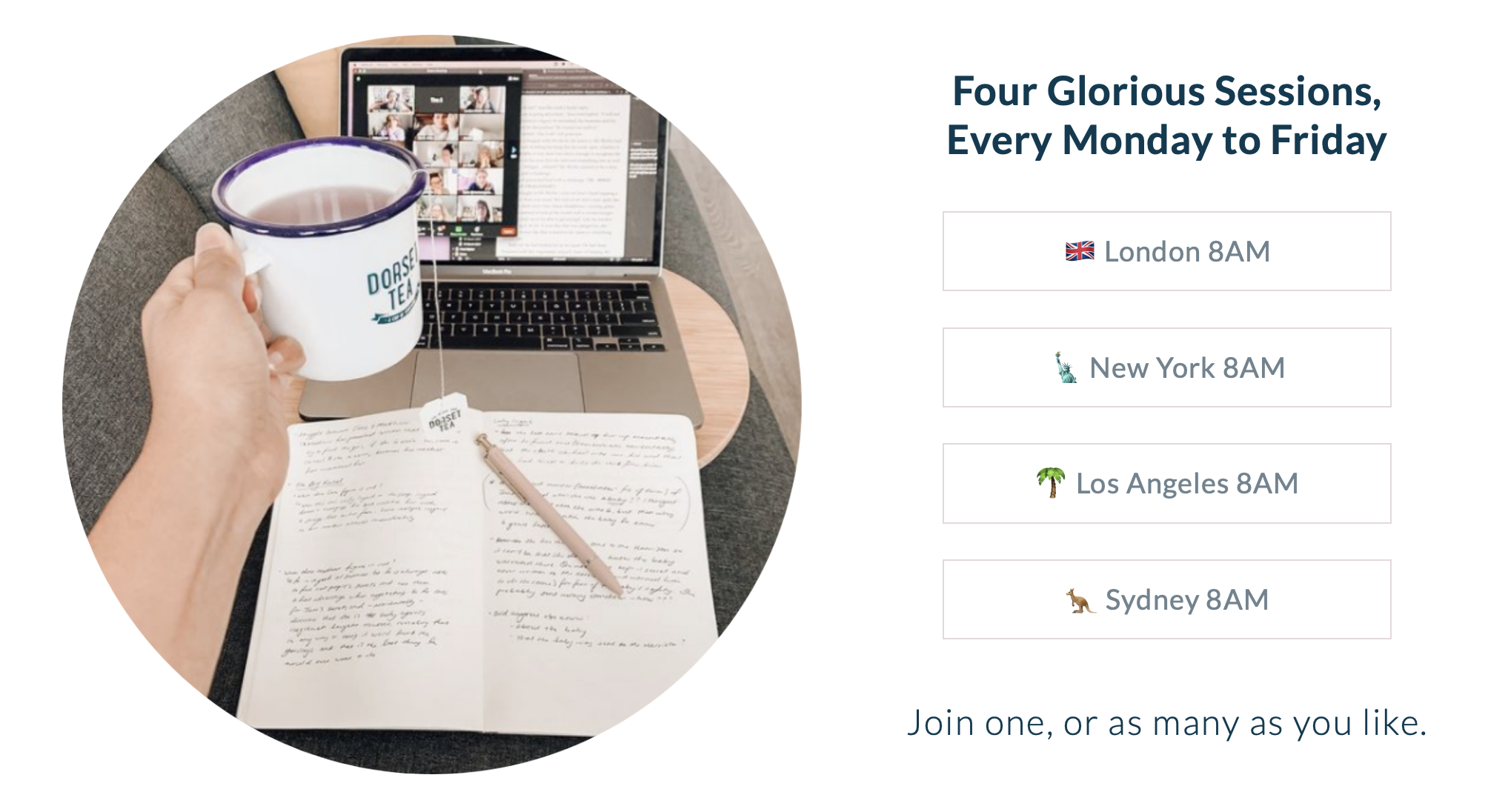
Come write with people around the world!
It’s a wonderful ritual that I’m trying to do every weekday this month. I sometimes use it to do mundane writing like emails, but it’s often the place that I save for doing more thoughtful writing like a blog post or planning for an upcoming teaching session. There are often around 200 people in these Zoom rooms, some showing up for the first time alongside many repeat faces and long-time participants. It makes me—in my room, at my computer, by myself—feel like I’m not writing alone.
So there’s one example of lovely communal feeling.
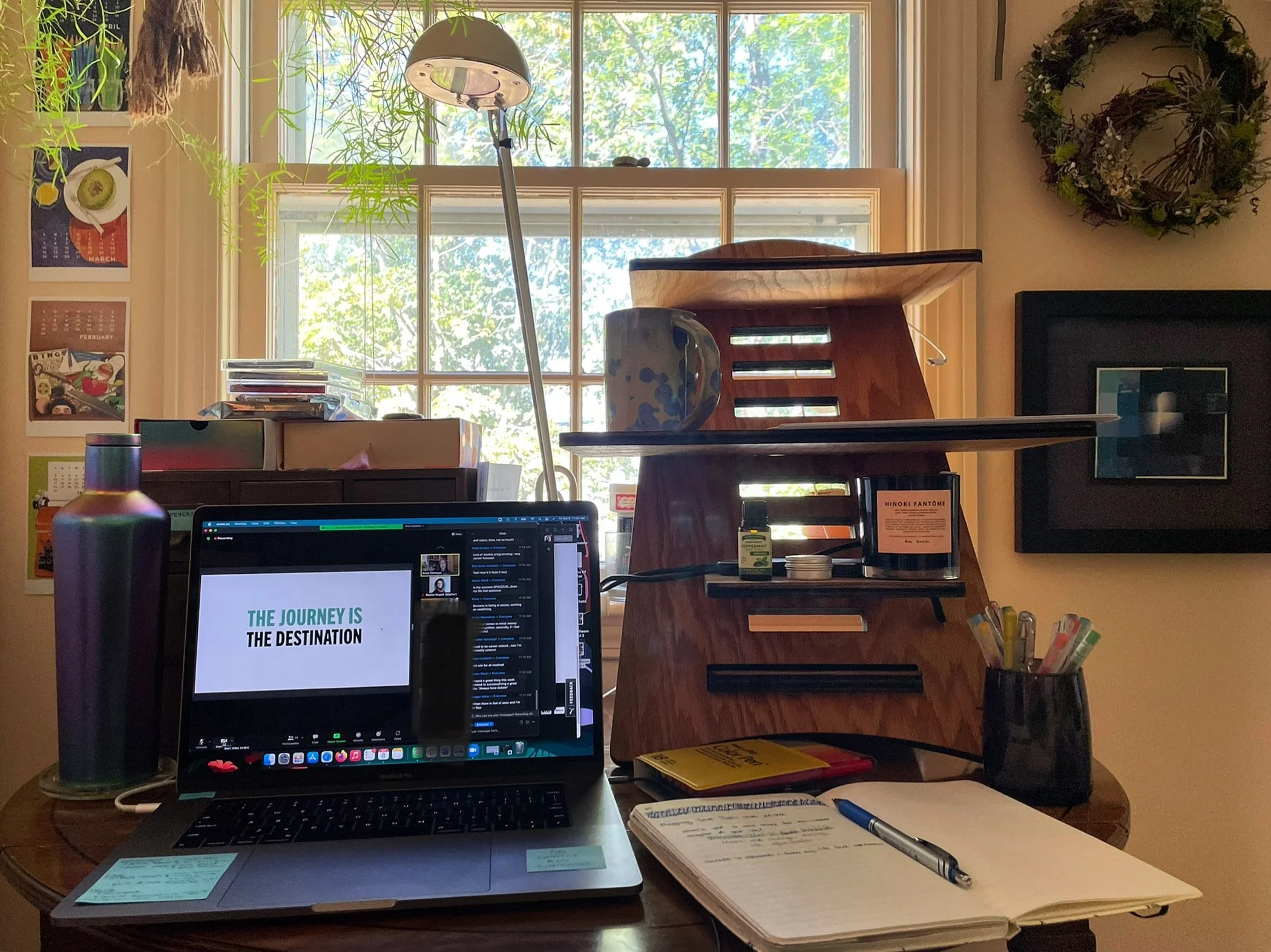
Just one of many Mapping Your Path moments.
I originally found out about Writer’s Hour from following Anne Ditmeyer on Instagram, where she mentioned it had become one of her quarantine rituals. When I later joined several rounds of her Mapping Your Path community, there were a number of people in there who also regularly show up at Writer’s Hour (actually, I see at least one of them present on the Zoom participants list right now as I write this).
Mapping Your Path is another community I’ve been immensely grateful for during the last year. It’s been a creative lab for me to test out ideas of how I want to work and move forward in my life without having to shave off too many pieces of myself to fit into overly-prescriptive institutional boxes. MYP is a guided community of people seeking more creativity in their lives, and it’s one of the major places where I began to figure out how I want the next phase of my career to look.
While digital communities aren’t the same as in-person ones (obviously), they come with some real benefits of lowering barriers to participation for folks in far-apart time zones, with various physical ability levels, who may be immuno-compromised and/or taking care of kids at home. I’ve been very interested in how these digital spaces can successfully feel like true communities, even if they’re not made up of people who’ve ever met in an offline space.
Because, of course—OF COURSE—we haven’t been able to meet in offline space the way we used to do. For years now.
And it’s easy to feel like it’s just a matter of time and finding a holding pattern until we’re able to see each other in groups, in person, indoors, again without worrying about COVID-19 transmission. But that’s an overly simplistic view that ignores both scientific facts about pandemic disease realities and also human nature realities about the changes in our social-emotional wellbeing.
I’ve been delighted by the few times I’ve rented an Airbnb with a small group of friends, done the responsible testing and masking, and been able to spend some long weekends with people I love. It’s been deeply satisfying to meet up one-on-one with friends and colleagues in physical space to share walks and talks and museum visits and coffees. I do indeed long for the time when I can plan a trip back to New York City to visit the people I shared space and time and experience with for a decade and a half.
But my social energy is absolutely not at the same place it was 2.5 years ago. I don’t know when I’ll be able to think about going to see live music or theater (which I miss SO DEEPLY) without anxiety about how many bodies are sharing one space.
I’m not holding the online/in-person dichotomy as an either/or. My online communal experiences have been sustaining me for two years, and I don’t see why that needs to stop.

I’m loving hosting the Museums As Progress community’s Campfire chats, which put me in conversation with smart, interesting people on the topics they’re passionate about.
The ridiculous text threads that I can scroll back through from group-watches of movies or episodes of Great British Bake Off are testament to the joy and hilarity that digital communication has brought me with friends I haven’t been able to see in person since 2019.

Lost Jobs, Found Voices, coming soon(ish) to you!
Lost Jobs, Found Voices (the documentary theatre piece that I’m putting together with Alli Hartley-Kong and Mimosa Shah about professional loss in the cultural institution sector) is a project I am incredibly invested in. Not only have Alli, Mimosa, and I never all three met up in person together, but all the people who volunteered their stories of loss for the project did so as strangers, offering up some of the most emotional, vulnerable, impactful moments of their lives to be shared.
I’ve used the phone and FaceTime more in the last two years than I think I’ve ever done in my life. I’ve reconnected with former colleagues and friends from undergrad and grad school and traveling and previous phases of my career. I’ve exchanged postal mail and remembered how much fun it is to buy stamps and stationery.
I don’t say all of this as a paean to remote communication. I have spent a lot of the past two years feeling stymied and stuck and depressed and lonely.
I’ve also spent that time feeling some of the deepest and most appreciated support and communal warmth from people in my life and tried to return that as much as I can.
One of my core values that’s become especially clear to me in the past few years is COLLECTIVITY. I’m trying to be guided by communal choices and decisions and to be intentional about connecting with people in whatever mode that may be. It’s part of what feeds the spirit behind Interchange. It’s something that feeds me, and hopefully others.
So here’s my pledge: I’m going to write one physical note to someone each week throughout this year. I’m 6 weeks into this and 6 notes out into the world. Perhaps one of those notes has or will be coming to you at some point.
Here’s to communality in all the ways we can find!
And that’s the end of Writer’s Hour, so I’m wrapping up here and off to post.
Sources of Community Mentioned in this Post:
Sending people handwritten notes
Creative Prompt Coda: Write and mail someone a physical note!